Written by HydroFlow Drainage Engineers
In 15 years attending drainage call-outs across Preston and Lancashire, we've cleared thousands of blocked drains. The causes are almost always the same — and almost always preventable.
City & Guilds qualified · NADC members · Environment Agency registered waste carrier · 15+ years serving Preston
After attending more than 2,500 drainage call-outs across Preston and Lancashire, we have a clear picture of what actually causes blocked drains — and which prevention habits genuinely make a difference. The patterns are remarkably consistent: the same handful of causes account for the vast majority of blockages we clear every week, and almost all of them are avoidable.
This post shares what we have learned from the field. Not a generic list of tips you could find anywhere, but the specific causes we encounter most often in Preston homes, the warning signs that tell us a blockage is developing before it becomes a crisis, and the prevention steps that actually work.
From Our Preston Call-Out Data
What We Actually Find in Preston Drains
Preston's housing stock creates a specific set of drainage challenges. The Victorian and Edwardian terraces in Ribbleton, Ashton-on-Ribble, and Deepdale have clay drainage pipes that are now 80–120 years old. The joints between clay pipe sections are the weak point — they allow tree root ingress and silt accumulation in a way that modern plastic pipes do not. In these areas, we see a much higher proportion of root-related blockages and partial collapses than in newer estates in Fulwood or Penwortham.
Across all property types, the causes we encounter most frequently are:
- Fat, grease and cooking oil (38% of residential call-outs): Poured down kitchen sinks, these solidify as they cool and gradually narrow the pipe bore. In terraced houses with shared drainage runs, one household's grease can cause a blockage that affects several properties.
- Wet wipes and sanitary products (24%): Despite 'flushable' labelling, wet wipes do not break down in water. They travel a short distance, catch on a pipe joint or partial blockage, and form a dense mass. We remove wet wipe blockages from Preston sewers on a near-daily basis.
- Tree root ingress (19% — concentrated in older clay pipe areas): Tree roots are drawn towards moisture in pipe joints. Once inside, they grow rapidly, eventually causing a complete blockage or structural collapse. This is the most expensive type of blockage to fix.
- Hair and soap scum in bathroom drains: Hair combines with soap residue to form a sticky mass that catches other debris. Even a small amount of hair can build up into a significant blockage within a few months.
- Leaves and outdoor debris (seasonal): External gullies and drains block quickly in autumn. We see a noticeable spike in gully-related call-outs in October and November across Preston.
Warning Signs We Tell Customers to Watch For
When a customer calls us, we always ask the same diagnostic questions. The answers tell us whether we are dealing with a branch pipe blockage (affecting one fixture) or a main sewer blockage (affecting the whole property). Knowing the difference helps you decide how urgently you need to act.
- Slow draining water in a single sink or bath — likely a branch pipe blockage, lower urgency
- Slow draining across multiple fixtures simultaneously — main sewer blockage, act quickly
- Gurgling sounds from the toilet when you run a bath or sink — air being pushed back through the system
- Sewage smell from drains, particularly in the morning — partial blockage allowing gases to escape
- Water backing up in the bath when you flush the toilet — the main drain is nearly blocked
- Water pooling in the garden or around inspection chambers — the blockage may already be overflowing
Real Job: Grease Blockage, Ashton-on-Ribble (March 2026)
A customer on a Victorian terrace in Ashton-on-Ribble called us after their kitchen sink had been draining slowly for three weeks. By the time we arrived, the drain was completely blocked and water was backing up into the sink. Our engineer found a dense grease and fat plug approximately 4 metres down the kitchen branch pipe — the result of years of cooking fat being poured down the sink.
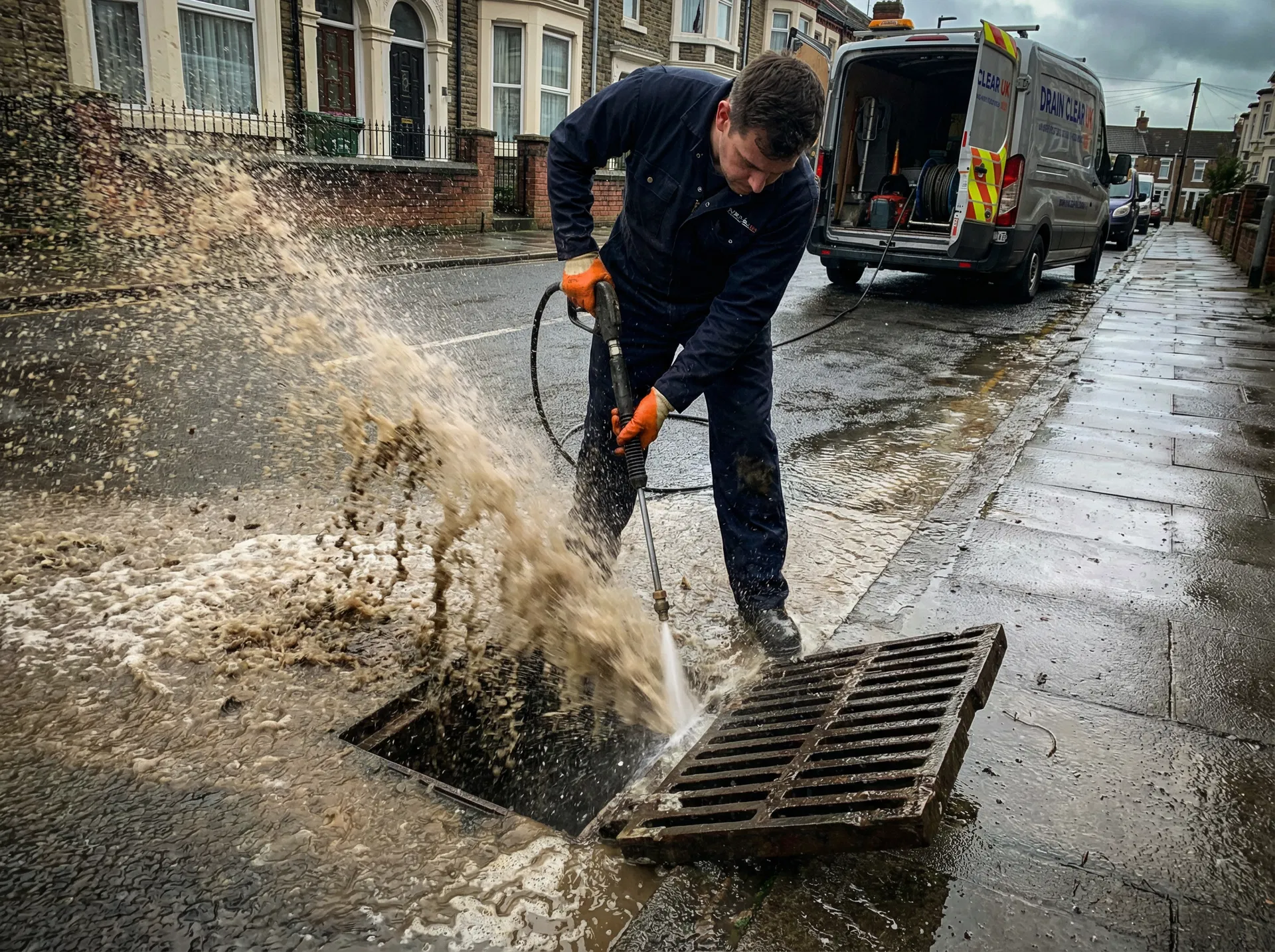
We cleared the blockage with high-pressure jetting in under 40 minutes. The customer mentioned they had been using boiling water and drain cleaner for weeks without effect — which is consistent with what we see: chemical drain cleaners rarely penetrate a solid grease plug, they just dissolve the outer layer.
Outcome: Drain cleared, customer advised on fat disposal. No further call-outs from this address in the following 4 months.
Prevention Steps That Actually Work
Based on what we see in the field, these are the prevention habits that make a measurable difference:
Kitchen Drains
- Never pour cooking fat, grease, or oil down the sink — cool it in a container and bin it. This single habit would eliminate roughly a third of the residential call-outs we attend.
- Use a sink strainer to catch food debris and empty it after every wash-up session.
- Run hot (not boiling) water down the drain after washing up to flush away residual grease before it can solidify.
- Avoid putting coffee grounds, rice, pasta, or starchy foods down the drain — they accumulate and bind with grease.
Bathroom Drains
- Fit a hair catcher over your shower and bath drain and clean it after every use — this is the single most effective bathroom drain prevention measure.
- Never flush wet wipes, cotton buds, sanitary products, or nappies — bin them. The 'flushable' label is misleading; they do not break down.
- Avoid excessive bath products, which leave a soap scum residue that binds with hair in the drain.
Older Properties (Clay Pipe Areas)
If your property is in Ribbleton, Ashton-on-Ribble, Deepdale, or any other area built before 1950, we recommend a CCTV drain survey every 3–5 years to check for root ingress and joint deterioration. Catching a partial root blockage early — before it causes a full collapse — can save thousands in repair costs.
When to Call a Professional
- Multiple drains are slow or blocked simultaneously — this is a main sewer blockage
- Your toilet is overflowing or sewage is backing up into the property
- A blockage keeps returning within weeks of being cleared — there is an underlying structural cause
- You can smell sewage but cannot identify the source
- Water is pooling in your garden or around inspection chambers
HydroFlow Drainage Preston provides drain unblocking, CCTV drain surveys, and 24/7 emergency drainage across Preston and Lancashire. If you are experiencing any of the above, call us on 01772 393 127 — we aim to be on-site within 60 minutes.
Frequently Asked Questions
What is the single most common cause of blocked drains in Preston homes?
Based on our call-out data, cooking fat and grease accounts for around 38% of all residential blockages we attend. It solidifies in the pipe as it cools, gradually narrowing the bore until nothing can pass.
Do wet wipes really cause blocked drains?
Yes — and they are one of the most damaging causes we encounter. Despite 'flushable' labelling, wet wipes do not break down in water. We remove wet wipe blockages from Preston sewers on a near-daily basis.
What are the early warning signs of a blocked drain?
Slow draining water, gurgling sounds after flushing, sewage smells, and water backing up in one fixture when you use another are all early warnings. If multiple drains are slow simultaneously, the blockage is in the main sewer.
Can I unblock a drain myself?
A plunger can shift a minor sink blockage. For main sewer blockages, tree root ingress, or recurring blockages, call a professional. Attempting to rod a serious blockage without the right equipment often pushes the material further down the pipe.
How often should drains be professionally cleaned?
For most Preston homes, every 18–24 months is sufficient. Older properties with clay pipes in Ribbleton, Ashton-on-Ribble, and Deepdale benefit from annual maintenance due to higher root ingress risk.